
It’s 11 PM. Your exam starts in ten hours, and you haven’t opened your notes yet. Your heart is racing, your hands feel cold, and panic is creeping in. If this sounds like you right now, take a breath. You are not the first person to face this situation, and you won’t be the last. Thousands of students pull through last-minute study sessions every single year and still pass with good grades.
Cramming isn’t ideal. Nobody will tell you the best way to learn. But when it’s your only option, the way you cram matters more than how much time you spend doing it. Random reading and re-reading won’t help you remember anything by morning. What you need is a smart, focused system built around how your brain actually stores information under pressure.
This guide walks you through science-backed memory techniques, quick revision hacks, and mental tricks that help you retain information fast, even with just one night left. Let’s get into it.
Why Last-Minute Studying Feels So Hard
Before jumping into techniques, it helps to understand why your brain struggles when you’re short on time. Memory works in three basic stages: encoding, storage, and retrieval. When you’re stressed and rushing, your brain skips proper encoding. Information goes in one ear and slides right back out because it was never processed deeply enough to stick.
Stress hormones like cortisol also interfere with your hippocampus, the part of your brain responsible for forming new memories. That’s why panic makes things worse, not better. The good news is that you can work around these limitations with the right strategy, even in a single nigh
Stop Trying to Study Everything
The biggest mistake students make during an overnight cram session is trying to cover the entire syllabus. This spreads your attention too thin, and you end up remembering almost nothing clearly.
Instead, prioritize. Go through your syllabus or course outline and mark topics based on three categories:
- Topics that appear most often in past papers or sample questions
- Topics your teacher emphasized in class or repeated multiple times
- Topics worth the most marks
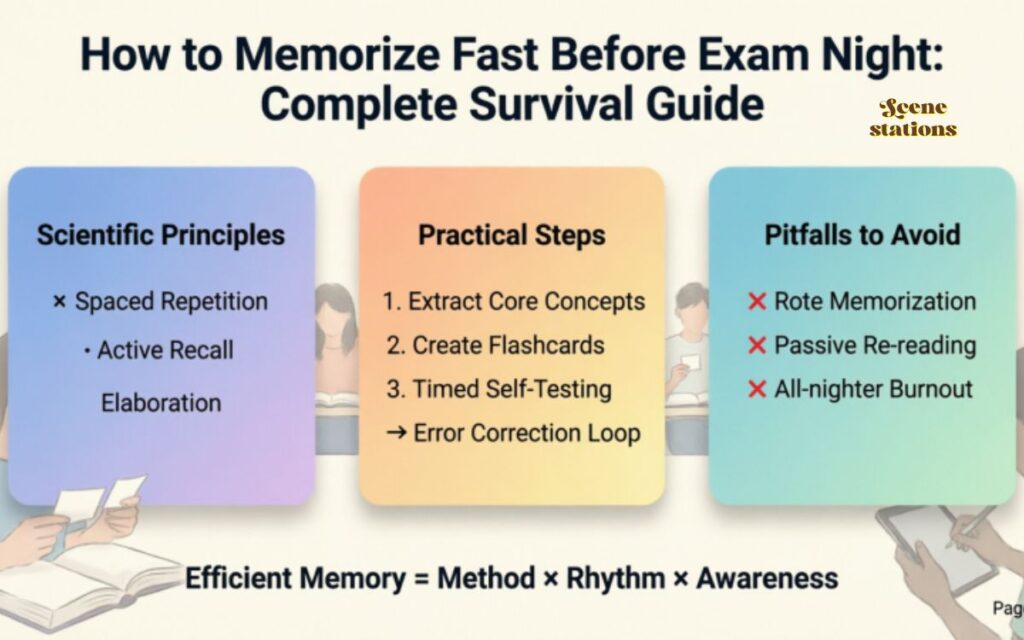
Focus your entire night on these high-yield areas first. If you finish early, move to smaller or less important topics. This selective approach, sometimes called strategic studying, ensures you walk into the exam knowing the sections most likely to appear, rather than knowing a little bit of everything.
Use Active Recall Instead of Passive Reading
Most students spend hours highlighting textbooks and reading notes over and over. It may seem productive, but it’s one of the least effective ways to retain information. Your brain recognizes the words on the page without truly learning them.
Active recall flips this process. Instead of reading information, you test yourself on it. Close your book, then try to write down or say out loud everything you remember about a topic. This forces your brain to retrieve information, which strengthens the neural pathway connected to that memory far more than passive reading ever could.
Here’s a simple way to apply active recall tonight:
- Read a section once, slowly and with full attention.
- Close the book and write a quick summary from memory.
- Check what you missed and reread only those missed points.
- Repeat the recall step until your summary matches the source material closely.
This method takes slightly longer per topic, but the information sticks far better, which saves you time overall since you won’t need to reread the same page five times.
Apply the Feynman Technique for Tricky Concepts
If a topic feels confusing or overly technical, try explaining it in the simplest words possible, as if you were teaching it to a ten-year-old. This is called the Feynman Technique, named after physicist Richard Feynman, who believed true understanding means being able to simplify any idea.
Grab a blank sheet of paper and write the topic name at the top. Then explain the concept using plain language, short sentences, and everyday examples. Avoid jargon and textbook phrasing entirely. If you get stuck or start using complicated words to cover a gap in understanding, that’s a signal you need to go back to your notes and clarify that specific part.
This technique works incredibly well for one-night study sessions because it exposes weak spots in your understanding immediately, rather than letting you assume you know something you don’t.
Break Your Night into Focused Study Blocks
Studying for six hours straight without breaks sounds efficient, but your brain’s attention span drops sharply after around 25 to 45 minutes of focused work. Instead of one long marathon session, break your night into structured blocks.
A popular method is the Pomodoro Technique, where you study intensely for 25 minutes, then rest for 5 minutes. After four rounds, take a longer 15 to 20 minute break. During an overnight cram session, you can stretch these blocks slightly, such as 40 minutes of study followed by a 10-minute break, since you have limited hours and need to cover more ground.
During breaks, avoid your phone or social media. Scrolling feeds actually tires your brain more than it rests it. Instead, stand up, stretch, drink water, or walk around the room for a few minutes. This keeps your mind fresh without pulling you into a distraction spiral that eats up precious time.
Use Mnemonic Devices to Lock In Information

Mnemonics are memory shortcuts that turn complicated or abstract information into something easier to recall. They work particularly well for lists, sequences, formulas, and definitions, which are common trouble spots during exams.
Some mnemonic techniques you can use tonight include:
Acronyms: Take the first letter of each item in a list and form a memorable word or phrase. For example, students memorize the order of biological classification using “King Philip Came Over For Good Soup” to remember Kingdom, Phylum, Class, Order, Family, Genus, Species.
The Memory Palace Method: Picture a place you know extremely well, like your childhood home. Mentally place each piece of information you need to remember in a specific location within that space, such as the doorway, kitchen counter, or bedroom. When you need to recall the information during your exam, mentally walk through the space and “pick up” each item along the way. This ancient technique, used by memory champions worldwide, works because our brains are naturally wired to remember spatial layouts and vivid imagery far better than plain text.
Chunking: Break long strings of numbers, dates, or facts into smaller groups. Phone numbers are chunked for this exact reason. Instead of memorizing ten random digits, you remember three small groups.
Rhymes and songs: Turning facts into a rhythm or short song makes them far stickier in your memory. This is why children’s educational songs remain in adult memory decades later.
Pick whichever mnemonic fits the type of content you’re revising, and don’t be afraid to make it silly or exaggerated. Weird and vivid associations are actually easier for your brain to hold onto than boring, straightforward ones.
Teach the Material to Someone (Even an Imaginary Student)
Teaching forces a much deeper level of processing than simply reading or listening. If you have a friend, sibling, or family member willing to listen, explain a topic to them out loud as though you’re the teacher and they’re the student. If nobody’s around, talk to an empty chair, a pet, or even just yourself in front of a mirror.
This may feel awkward, but it exposes gaps in your understanding instantly. If you fumble while explaining something, that’s your cue to revisit your notes on that exact point. Verbalizing information also engages a different part of your brain compared to silent reading, which reinforces memory through multiple channels.
Write Things Down by Hand
Typing notes is fast, but handwriting activates deeper cognitive processing. Research on learning and memory retention consistently shows that students who write notes by hand tend to remember material better than those who type, because handwriting forces you to summarize and process information rather than copying it word for word.
During your overnight session, rewrite key formulas, definitions, dates, and diagrams by hand on a single summary sheet. This also gives you a condensed, personalized “cheat sheet” style summary you can glance at right before the exam starts, without flipping through an entire notebook.
Use Visual Aids and Diagrams
Our brains process images far faster than plain text. If a topic involves processes, timelines, relationships, or cause-and-effect chains, draw it out instead of writing paragraphs about it.
Flowcharts work well for step-by-step processes. Mind maps are an effective way to organize and connect ideas around a central concept. Simple timelines work well for historical events or sequences. Even quick, rough sketches help your brain form a visual memory tag that’s easier to recall under exam pressure than a wall of text.
Sleep Matters More Than You Think
It’s tempting to stay awake the entire night, but pulling a full all-nighter often backfires. Sleep plays a critical role in memory consolidation, the process where your brain transfers information from short-term to long-term memory. Skipping sleep entirely means your brain never gets the chance to lock in what you studied.
If possible, aim for at least 3 to 4 hours of sleep before your exam, even if that means cutting your study session short. A tired, foggy brain performs worse on recall and problem-solving than a brain that got a small amount of rest. If you truly cannot sleep, even a 20 to 30 minute power nap in the early morning hours can noticeably sharpen your focus and memory before the exam.
Fuel Your Brain the Right Way
What you eat and drink during your study session affects how well you concentrate and remember information. Avoid heavy, greasy foods that make you sluggish. Instead, snack on foods known to support brain function, such as nuts, fruit, yogurt, or dark chocolate in moderation.
Stay hydrated throughout the night. Dehydration is a sneaky cause of brain fog and poor concentration that many students overlook during late-night study sessions. Limit caffeine to moderate amounts spaced throughout the night rather than one large dose, since too much caffeine too quickly can spike anxiety and actually hurt your focus rather than help it.
Review Right Before You Sleep Or Right After You Wake Up
Your brain processes and organizes memories during sleep, particularly information reviewed shortly before bedtime. Spend your final 15 to 20 minutes before sleep reviewing your most condensed summary notes, the ones with only the most critical facts, formulas, and key points.
Then, as soon as you wake up, do a quick 10 to 15 minute review of that same summary sheet again. This morning refresh reactivates the information while it’s still fresh from the consolidation that happened during sleep, making it far easier to recall once you’re sitting in the exam hall.
Manage Exam-Day Anxiety
Even with solid preparation, nerves can make your mind go blank during the exam itself. A few quick techniques can help calm your nervous system right before you walk in:
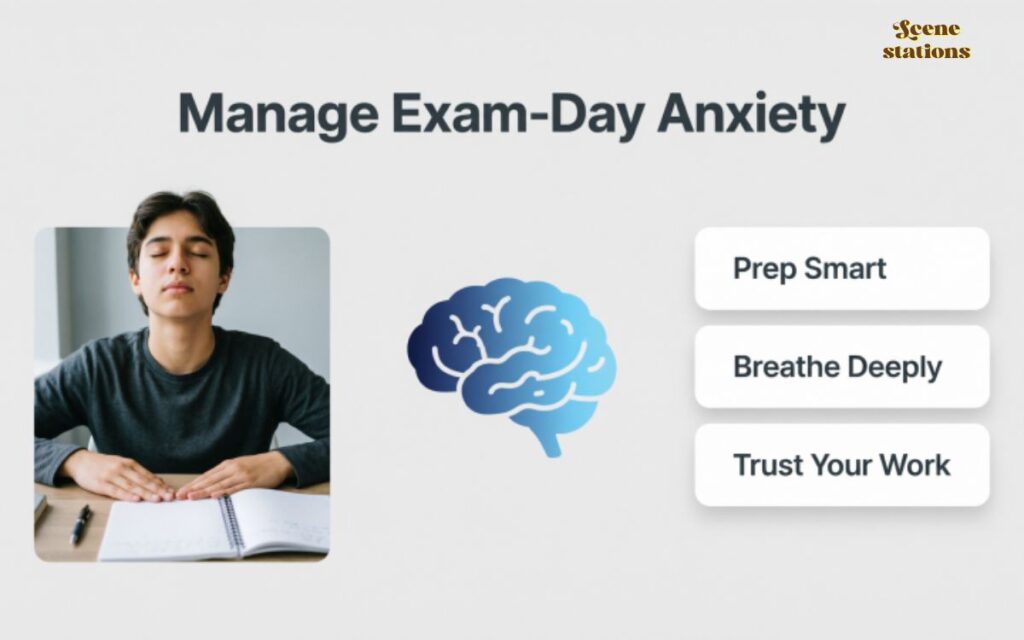
- Take slow, deep breaths for a minute or two, inhaling for four counts and exhaling for six.
- Avoid discussing the exam with anxious classmates right before entering, since panic is contagious.
- Remind yourself that you prepared using a focused, strategic method, not random guesswork.
- Once inside, skim through the entire question paper first, and start with questions you feel most confident about. This builds momentum and reduces pressure before tackling harder questions.
Frequently Asked Questions
1. Can you actually memorize a whole chapter in one night?
Yes, to a reasonable extent. You won’t retain every single detail, but by focusing on high-yield topics, using active recall, and applying mnemonic techniques, you can absorb the core concepts and key facts well enough to answer most exam questions confidently.
2. Is it better to stay up all night or sleep a few hours before an exam?
Sleeping a few hours is almost always better than pulling a full all-nighter.Your brain strengthens and organizes memories while you sleep. Even getting 3 to 4 hours of rest can improve recall more than pulling an all-nighter.
3. How can I memorize my notes quickly before an exam?
Active recall is the fastest and most effective method. Instead of rereading notes, close your book and try to write or say what you remember. Combine this with mnemonics, summary sheets, and short focused study blocks for the best results.
4. How many hours of sleep are enough before an exam?
Even a short sleep window of 3 to 4 hours can significantly improve memory recall and focus compared to no sleep at all. If time is extremely tight, a 20 to 30 minute power nap in the early morning still helps sharpen concentration.
5. Does listening to music help while cramming for an exam?
Instrumental or lyric-free background music can help some students focus, but songs with lyrics often distract your brain and interfere with information encoding. If you’re short on time, silence or soft instrumental music usually works best.
6. What foods help you concentrate and remember better while studying?
Light, brain-friendly snacks like nuts, fruit, yogurt, and dark chocolate support focus without making you sluggish. Staying hydrated is just as important, since even mild dehydration can cause brain fog and reduce concentration.
7. How do you stop panicking before an exam after an all-night study session?
Slow, deep breathing for a minute or two calms your nervous system quickly. Avoid anxious classmates right before the exam, remind yourself of the strategic plan you followed, and start the exam with the questions you feel most confident about to build momentum.
Final Thoughts
Studying for an exam in one night isn’t the ideal way to learn, but it’s a reality many students face at some point. The difference between a productive all-nighter and a wasted one comes down to strategy. Prioritize high-yield topics, use active recall instead of passive reading, apply mnemonic devices for tricky material, write summaries by hand, and don’t skip sleep entirely if you can help it.
Your brain is capable of remarkable things under pressure, especially when you give it the right tools instead of just more hours. Walk into your exam with a clear plan, a calm mind, and trust in the preparation you managed to squeeze into the hours you had. You’ve got this.
See Other Posts

Ash Williom has spent years writing puns, wordplay, and internet slang guides for Scenestations.com, with a habit of testing every joke on real friends and family before it makes the list. When not chasing down the perfect one-liner, Ash is usually knee-deep in group chats collecting new material or digging into how internet slang actually spreads across platforms.