I started collecting Chinese jokes after a WeChat group I’m part of turned into a nightly joke-off, and I quickly learned something: half the “Chinese jokes” floating around the internet aren’t funny at all once you actually read them out loud to someone. They read like a list someone generated in five minutes. So I spent weeks testing jokes on real people, coworkers, my study group, random cousins on family video calls, and eventually my old backpacking group chat too and kept only the ones that actually got a laugh, a groan, or a “wait, say that again.”
Numbers and Names: The Secret Weapon of Chinese Wordplay
The first time someone told me a Chinese number joke, I didn’t get it until they explained that in Mandarin, numbers sound like actual words. Once that clicked, half the jokes in this section suddenly made sense, and I’ve been hooked ever since.
Number jokes the ones that only work once you know the wordplay behind them:
- Why is 520 the most romantic number in China? Because said out loud, it sounds like “I love you.”
- 8 means wealth. 4 sounds like death. My landlord skipped floor 4 entirely — I didn’t ask questions.
- What does 250 mean if someone calls you that in China? It means you’re acting a little silly. Don’t be a 250.
- Why do Chinese couples love the date May 20th? Because 5-2-0 says “I love you” without anyone having to say it.
- “Why does your Wi-Fi password have three 8s?” — “I like being lucky, even with my internet.”
- Why did grandma refuse a clock as a birthday gift? A clock sounds like “the end.” She wanted candy instead.
- 168 sounds like “the road to getting rich.” My uber driver had it as his license plate. Make of that what you will.
- 5201314 reads out as “I love you forever and ever.” It’s basically a marriage proposal in digit form.
- “You got a 100 on the exam?” — “Yeah, but my dad says 100 also means ‘you must keep pushing.’ So no rest for me.”
- Why is the number 1,000,000 kind of sad in Chinese wordplay? Because it doesn’t have a “wan” (10,000) around to keep it company.
Name jokes for anyone who’s ever had to explain their Chinese name three times at a coffee shop:
- Why do Chinese names sound like tiny poems? Because every character was picked to mean something, not just sound nice.
- “What’s your Chinese name?” — “Ask me after coffee. I need to remember the tone first.”
- Why did my teacher rename half the class “Xiaoming”? Textbook characters run out of patience fast.
- What do you call someone named after a dragon? Automatically the main character of the family.
- “Wang is such a common surname.” — “Yeah, but every Wang insists theirs is the original one.”
- Why did grandpa pick my name from a poem? He said a name from a book lasts longer than one from a trend.
- “Your name means ‘bright future.'” — “Cool, no pressure then.”
- Why do parents avoid naming kids after emperors? Apparently the ego doesn’t fit in a stroller.
If naming traditions are your thing, our funny Asian names roundup goes even deeper into the stories and meanings behind these picks.
Food and Festival Jokes for When Everyone’s Together
I’ll admit it — I didn’t get half of these food jokes until a coworker walked me through an actual dim sum lunch and pointed at each dish while explaining the pun. Festival jokes came the same way, mostly from standing in my aunt’s kitchen during Chinese New Year prep, watching her eat three dishes at once while yelling at the TV.
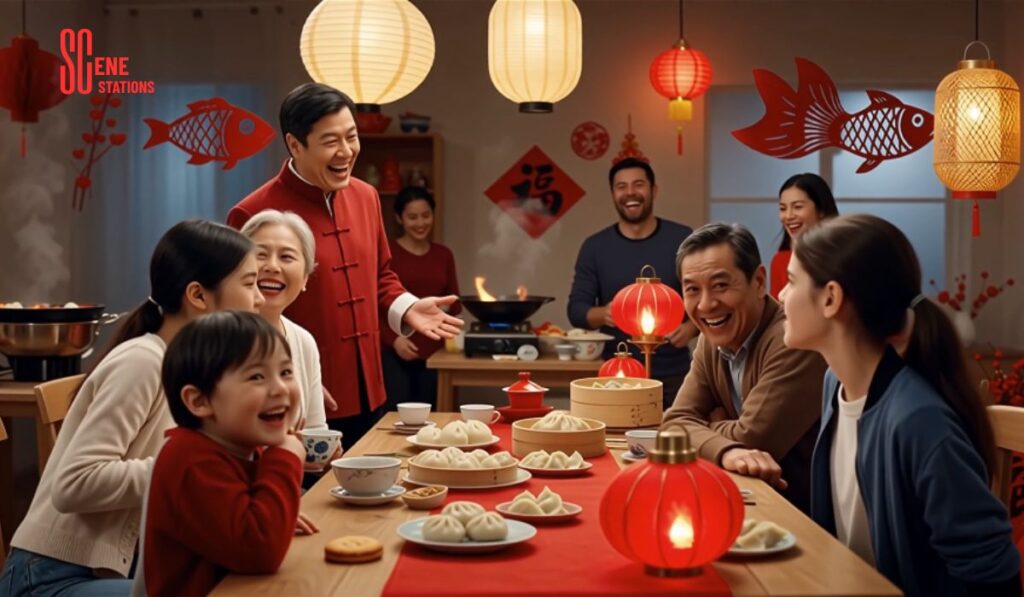
Food jokes — only land if you’ve actually had the food:
- Why did the dumpling need a break? Too many fillings to deal with, emotionally and literally.
- “I’m basically fried rice.” — “How so?” — “Simple, satisfying, and a little greasy by the end of the day.”
- What did the soy sauce whisper to the rice? “Don’t worry, I’ve got you covered.”
- Why do noodles make terrible secret-keepers? One slurp and the whole soup finds out.
- “You’re spicy.” — “Like hot pot?” — “Exactly. Full of surprises and slightly dangerous.”
- Why was the spring roll so confident walking into the room? It knew it was wrapped up perfectly.
- What’s a dumpling’s biggest fear? Getting left in the steamer and going cold and lonely.
- Why don’t pandas order fast food? By the time they catch up to the counter, the shop’s closed.
- “My memory is like a wonton.” — “Floating around and easy to lose track of?” — “Exactly that.”
- What do you call sad bok choy? A cry-yum cha. (Say it slow — it works.)
Festival and holiday jokes — for the loud, food-heavy chaos of Chinese New Year and Mid-Autumn Festival:
- Why does Chinese New Year cleaning feel like a full-body workout? Sweeping out bad luck burns more calories than expected.
- “Did you get your red envelope?” — “Yes, and I already spent it in my head twice.”
- Why do fireworks show up every New Year’s Eve? Loud noises apparently scare away more than just the neighbors.
- What’s the Mid-Autumn Festival’s favorite excuse? “I’m just here for the mooncakes, not the poetry.”
- “Why is everyone staring at the moon tonight?” — “Tradition. Also, dessert.”
- Why did dad light so many firecrackers? He said quiet New Years are bad luck, loud ones are memorable.
- What do dragons and lion dancers have in common during festivals? Both need at least two people to actually function.
- “How many dumplings did you eat for New Year’s?” — “Enough that counting felt disrespectful to my ancestors.”
A lot of Chinese humor comes from love disguised as mild criticism and food disguised as tradition, which honestly explains most family group chats during any holiday. If food puns are more your speed, our taco puns collection scratches the same itch from a completely different cuisine, and our Mexican jokes roundup runs on that same food-and-family energy from another culture entirely. And if your group chat runs on that same warm-but-critical energy, you’ll probably enjoy a set of birthday dad jokes that work the exact same way warm, a little cheesy, and impossible to say no to.
Zodiac Animals and “What If” Jokes for the Group Chat
My aunt takes the Chinese zodiac very seriously — she’ll bring it up at every family dinner to explain why my cousin is “too stubborn” (he’s an Ox) or why I’m “always late” (Rabbit, apparently). The “what if” jokes started as a bored side conversation during one of those same dinners, when someone asked what would happen if the zodiac animals could actually vote on things.

Zodiac jokes straight out of arguing with her about it:
- Why is the FIRST Rat in the zodiac? Classic move — he cheated the Ox out of first place and never apologized.
- What does the Ox say when you compliment his work ethic? “I show up. That’s the whole personality.”
- Why is the Tiger always so confident? Stripes are basically built-in designer clothing.
- What’s the Rabbit’s real talent? Running fast and making excuses even faster.
- Why does everyone secretly want to be the Dragon? Fire, swagger, and zero apologies.
- What did the Snake say when someone got too close? “When you’re zodiac royalty, personal space is apparently optional—but I’ll allow it.”
- Why is the Horse always lonely at parties? Too fast for the slow friend group.
- What’s the Goat’s biggest flaw? Too many opinions, not enough filter.
“What if” jokes for when the group chat gets a little too philosophical:
- What if pandas unionized? Bamboo breaks would triple overnight.
- What if dumplings could talk? Every dinner would turn into group therapy.
- What if Mandarin tones had subtitles? Half my conversations would finally make sense.
- What if red envelopes came with interest? Grandparents would basically run a bank.
- What if fortune cookies were honest? “You will eat this cookie and immediately forget the fortune.”
- What if hot pot had a referee? Someone needs to stop the double-dipping.
- What if the zodiac had a tiebreaker round? The Rat would still find a way to cheat.
- What if chopsticks came with a manual? Half the world would still just use a fork anyway.
Family and Travel Jokes (the Kind That Hit Close to Home)
My mom is the reason half of this list exists. Every time I tell her I’m full, she treats it like I’ve said something offensive. The travel jokes came later, from a backpacking trip through China where “quick stop” and “food tour” apparently mean the same thing to everyone in my family.
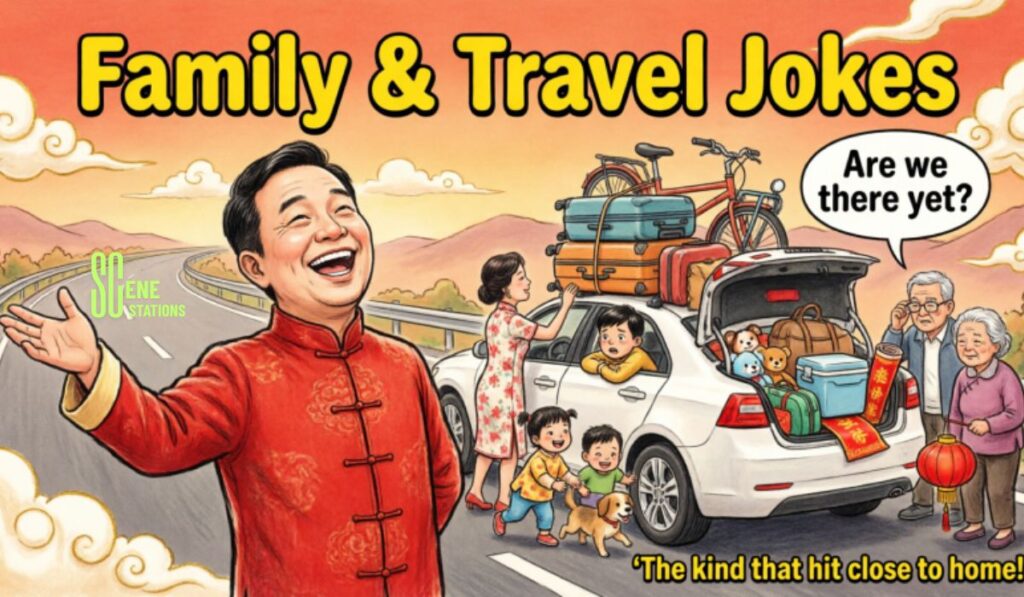
Family and parent jokes that feel less like jokes and more like transcripts:
- “I’m full, Mom.” — “That’s not a real word in this house. Eat more.”
- Why do Chinese parents love the piano so much? A quiet kid is automatically a suspicious kid.
- “Dad, can I borrow some money?” — “Sure — here’s one yuan. Spend it wisely and don’t come back.”
- My grandma’s love language is one sentence: “You’re too skinny. Eat this whole duck.”
- “I’ll call you every day,” I told my mom. She said, “No. Call every hour, or I’ll assume the worst.”
- Why do Chinese moms trust hot water over medicine? Because a thermos has never once let them down.
- “You look tired.” — “I have a toddler.” — “Ah. Could be worse. Could be three mothers-in-law.”
- Why did my uncle show up to every party with fish? “Good luck” doesn’t taste as good without leftovers.
Travel jokes for anyone who’s tried to see China on a schedule and failed immediately:
- Why did my backpacking trip through China turn into a food tour? Every “quick stop” ended at a noodle stall.
- “Which city has the best street food?” — “Wrong question. Ask which city doesn’t.”
- Why did the tour guide count heads three times before every bus ride? One uncle wandered off for photos every single stop.
- “How was the Great Wall?” — “Long. Longer than I expected. That’s the whole review.”
- Why do travelers always overpack snacks for the train? Twelve hours without food sounds like a personal attack.
- “Did you get lost in Shanghai?” — “Once. The skyline looked the same from every direction.”
- Why did my layover in Beijing turn into an accidental dumpling crawl? Boredom plus an airport food court is a dangerous combination.
- “Best travel tip for China?” — “Learn to say ‘no cilantro’ before anything else.”
New Year Homecoming Jokes
This one’s separate from the fireworks-and-red-envelopes side of the holiday already covered above. It’s about the specific chaos of actually getting the whole family under one roof — something I only fully understood the year I tried to book a train ticket home and watched the app sell out in under a minute.
- Why does booking a train ticket home for New Year feel like a competitive sport? Millions of people, one app, thirty seconds to decide.
- “How much do you make now?” the reunion dinner question nobody’s actually ready for.
- Why did my cousin stay up until midnight every New Year’s Eve? Apparently going to sleep early invites bad luck for the whole year.
- “Are you seeing anyone?” asked at least four different relatives before the appetizers even arrive.
- Why does packing gifts for New Year visits take longer than packing for the actual trip? Every relative needs a specific, correct gift.
- What’s the real challenge of the reunion dinner table? Finding a seat that isn’t directly across from the relative who asks too many questions.
- Why did the whole family cram into one overnight train every year? Flying was faster, but somehow less of a tradition.
- “Did you bring the red envelopes?” The one question that determines just how warmly you’re welcomed at the door.
Office, WeChat, and Classroom Jokes for the 9-to-5 (and the Homework) Crowd
I work with a few colleagues from Shanghai, and our team chat turned into a place where half the “urgent” messages are actually just jokes about deadlines. The classroom jokes are courtesy of my cousin, who still complains about her strict Mandarin teacher every time the topic comes up.

Office and WeChat jokes that made it past the group’s approval:
- Why does everyone love the number 8 in meetings? It sounds like “prosper,” and nobody’s turning down a bonus.
- “The meeting is at 8.” — “AM or PM?” — “Yes.”
- Why did my coworker bring tea to every stressful meeting? Steeping on the problem felt more productive than panicking.
- “You are fired.” Can you say that again in Mandarin? I think I misheard you.
- What’s a spreadsheet’s favorite lunch? Dumplings — because it’s already full of filling.
- Why did the printer cry during the Chinese New Year season? It ran out of red ink for the lucky envelopes.
- “This deadline is impossible.” — “In Chinese, we don’t say impossible. We say ‘not yet possible.'”
- “I’ll send the report today.” — Send a panda sticker instead. Somehow, that counts as an update.
School and classroom jokes for anyone who’s sat through a strict Mandarin class:
- Why did the teacher separate the twins on exam day? Apparently “same brain, same answers” isn’t a valid excuse.
- “Did you finish your homework?” — “Define finish. I opened the notebook, that counts for something.”
- Why do Chinese classrooms love morning reading aloud? Waking the whole hallway up is basically a school tradition.
- “What’s your favorite subject?” — “Lunch. It’s technically on schedule.”
- Why did my cousin’s Mandarin class have a strict seating chart? Talking during dictation was apparently a serious offense.
- “How was the exam?” — “I wrote something. Whether it was correct is a separate question.”
- Why do teachers love red pens so much? Nothing said “try again” quite as loudly.
- “Extra credit?” — “Only if you can recite it without looking at your notes.”
If deadline humor is your thing, our roast jokes collection has a similar bite, a little savage, still safe enough to send to your work chat without HR getting involved.
Dating and Relationship Jokes (Clean, Not Cheesy)
A friend of mine got proposed to on May 20th — she didn’t clock the joke until her fiancé explained the number meant “I love you.” She still brings it up as the moment she knew he’d actually done his research.
- “You’re my 520.” — “Aww. And you’re my 1314 — forever and always.”
- Why did the couple almost break up over one text? He typed “I like you” in the wrong tone, and she read it as “I’ll boil you.”
- “Our relationship is like a teacup.” “Warm & needs patience to get right?” — “Exactly.”
- What’s a boyfriend’s go-to apology in Chinese culture? Silence, then a cup of milk tea shows up at your desk.
- “You are looking like a dumpling today.” “Should I take that as cute and comforting?” — “Yes. Also a little stuffed, no offense.”
- Why did she laugh mid-date? He accidentally said “I love you” to the waiter instead of her.
- What’s a romantic panda’s best pickup line? “You’re un-bear-ably pretty, and I mean that with my whole diet.”
- Why do couples bond over hot pot? Shared spice level is basically a relationship milestone.
If you’re after actual opening lines instead of jokes, our Filipino pick-up lines and volleyball pick-up lines collections are worth a look — same clean, tested-on-real-people approach, just built for a different opening move.
Wedding Jokes
My cousin got married last year, and between the matchmaker aunties comparing notes and the relatives quizzing everyone about their relationship status, I collected enough material for this entire section in one afternoon.
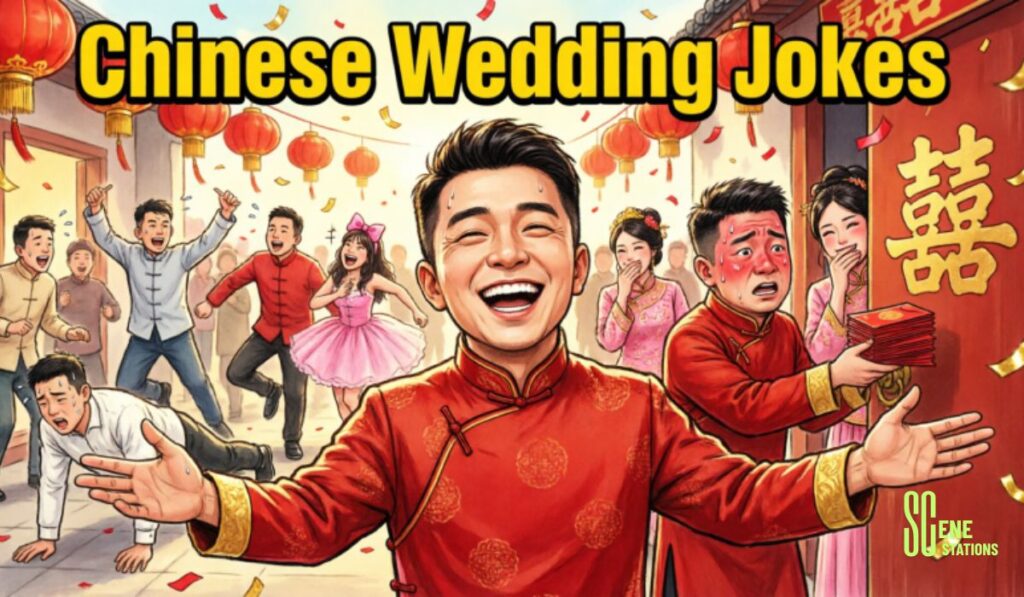
- Why do Chinese weddings need three outfits per bride? One ceremony, three costume changes, zero complaints allowed.
- “Have you found someone yet?” the question most asked at every single relative’s wedding, aimed directly at you.
- Why did the matchmaker aunt bring a spreadsheet to dinner? She’s not leaving until someone’s engaged.
- What’s the real MVP of a Chinese wedding banquet? The uncle who remembers everyone’s toast order.
- “How much should I put in the red envelope?” — the one wedding question nobody answers the same way twice.
- Why do Chinese wedding banquets never seem to end? Ten courses in, someone’s still ordering more dishes “for luck.”
- What did the groom say after changing outfits for the fourth time? “I didn’t believe, I signed up for a fashion show.”
- Why did grandma cry at the wedding before the ceremony even started? She was just excited about the food menu.
Mahjong Jokes
The mahjong table started up at that same wedding the second the banquet ended, and I realized the game runs on its own kind of family energy — everyone’s competitive, everyone’s got an opinion, and nobody’s leaving early.
- Why does mahjong night always run past midnight? Nobody wants to be the one who quits while losing.
- “One more round.” — Every mahjong player, every single time, for the last four hours straight.
- Why did grandma refuse to teach me her mahjong strategy? Some secrets are apparently meant for the grave.
- What’s the loudest sound in a Chinese household on a Sunday afternoon? Tiles slamming down like it’s a competitive sport.
- “Did you win?” — “No, but I made sure my brother-in-law lost more, so it still feels like a win.”
- Why do mahjong tables always have snacks nearby? Losing hurts less with sunflower seeds in hand.
- What’s the unwritten rule of family mahjong night? Nobody actually pays the full amount owed.
- Why did my uncle bring his lucky mahjong tile to every game? Superstition beats strategy every single time.
Tea Culture Jokes
Every visit to my grandparents’ house comes with a lesson on pouring tea properly, usually delivered right after I’ve already gotten it wrong.
- Why does pouring tea for elders come with so many rules? One wrong hand placement and you’ve apparently disrespected the whole family.
- “Which tea is this?” — “Does it matter? Just say it’s good and drink it.”
- Why did the tea ceremony take longer than the actual wedding? Every step apparently needs its own bow.
- What’s the real skill in gongfu tea? Looking calm while secretly timing every single pour.
- “You added sugar to your tea?” the kind of judgment usually fixed for actual crimes.
- Why do tea leaves get read like fortunes at family gatherings? Because grandma trusts them more than the weather app.
- What’s the fastest way to end an argument at a Chinese dinner table? Someone quietly refills everyone’s tea.
- Why did my tea cup never stay empty at my grandparents’ house? Because an empty cup apparently means you’re unhappy there.
Chinese Medicine Jokes
My grandma has a remedy for everything, and none of them involve actually seeing a doctor. This section is basically a transcript of every visit to her house.
- “I have a headache.” — “Did you sleep with wet hair again? That’s the real problem.”
- Why does ginseng show up in every family remedy? Apparently it fixes tiredness, stress, and bad luck all at once.
- “Just eat more vegetables.” — the diagnosis for literally every symptom in a Chinese household.
- Why did my grandma keep tiger balm in every room of the house? You never know when a headache might strike.
- “Did you catch a cold?” asked immediately if you sneezed even once near an open window.
- What’s the go-to cure for a stomachache? A bowl of plain congee and a stern look from mom.
- Why do herbal soups always taste faintly like punishment? Apparently bitterness means it’s working.
- “You look pale.” — “I’m fine.” — “No, you need soup. Sit down.”
Jokes About Learning Mandarin (and Knock-Knocks to Practice On)
I tried learning Mandarin for eight months using an app, three textbooks, and one very patient tutor. I can now order noodles and apologize convincingly. That’s it. The knock-knock jokes came from that same tutor, who used them as a warm-up drill before every lesson — mostly, I think, to make me laugh before the tones destroyed my confidence again.
Learning Mandarin jokes, basically my personal diary from that period:
- Learning Chinese is simple, they said. Just 50,000 characters, no big deal.
- “What’s the tone for ‘mother’?” — “High and flat.” — “That’s also my mom’s exact mood most days.”
- Why did I cry once in class? I said “horse” instead of “mom” and the whole room went silent.
- “How many tones are there?” — “Four.” — “How many headaches does that cause?” — “At least five.”
- Why is pinyin sneaky? “Shi” can mean ten, yes, or poetry — good luck figuring out which one is mid-sentence.
- “I know ten words.” — “Which ones?” — “Hello, thanks, I want… okay, that’s four.”
- Why do beginners love Google Translate so much? Because the mistranslations are somehow the best part of the day.
- “I’ll be fluent within a year.” — Every single learner, every single time, myself included.
Knock-knock jokes, easy enough that even a beginner can deliver them:
- Knock knock. Who’s there? Wonton. Wonton who? Wonton know if you’re free for dumplings later?
- Knock knock. Who’s there? Panda. Panda who? Panda-monium happens every time the fridge is empty.
- Knock knock. Who’s there? Tofu. Tofu who? Tofu people showed up, so I made extra rice.
- Knock knock. Who’s there? Chow. Chow who? Chow down, dinner’s ready and getting cold.
- Knock knock. Who’s there? Ginger. Ginger who? Ginger-ally speaking, I always bring snacks.
- Knock knock. Who’s there? Noodles. Noodle who? Noodle you believe it, I forgot the soy sauce again.
- Knock knock. Who’s there? Mei. Mei who? Mei I come in, it’s freezing out here.
- Knock knock. Who’s there? Soy. Soy who? So glad you’re finally home, dinner’s been waiting.
Short One-Liners You Can Actually Text Someone
Not every joke needs a setup and a punchline. Some of the best ones are one sentence long and work perfectly as a text reply or a caption. These are the ones I keep saved for exactly that.
- I put the “pro” in procrastination, and somehow also in prosperity.
- My Mandarin is strong enough to say “I don’t understand” in three different tones.
- Happiness, defined simply, is a warm bun on a cold morning.
- I’m 90% noodles and 10% self-control on a good day.
- Tone-deaf in karaoke, tone-dead in Mandarin class — a package deal.
- Red envelope season hits different when your bank account is watching.
- Pinyin is a beautifully organized lie, and I respect it anyway.
- I’m not short — I’m compact, like a dumpling built for efficiency.
- Hot pot fixes everything. I don’t make the rules, I just eat the results.
- Good tea, a nap, and zero notifications — that’s the whole dream.
Dad Jokes, Chinese Edition
My dad doesn’t tell jokes so much as he deploys them at the worst possible moment. These are the ones that have survived multiple family dinners without getting banned from the table.
- I’m reading a book on Chinese dynasties. It’s a very long read — literally, the Tang dynasty alone took forever.
- Why don’t noodles need to work out? They’re already stretched to their limit.
- “I’m hungry.” — “Hi Hungry, nice to meet you. Now eat your rice.”
- What’s a panda’s dream car? Something with plenty of bamboo storage in the trunk.
- “This joke is old.” — “Older than Confucius, or just older than you?”
- Why did dad put his phone in the wok? He wanted the “fried rice” ringtone, obviously.
- Dad,I’ll be there in a minute. “That’s 60 seconds. I’m timing you.”
- What’s a dad’s favorite number? 8 — mostly because “baba” and luck go together nicely.
If your family runs on this exact brand of humor, a batch of dog puns hits the same groan-and-laugh combo — perfect for the same group chat that tolerates your dad’s jokes.
What I’ve Learned From Actually Testing These Jokes on People
Not every joke works on every crowd. Number jokes land hard with people who know Mandarin, but flop without a quick explanation first. Food jokes are the safest bet — everyone’s eaten a dumpling, no context needed.
The family and dad jokes get remembered longest, because they turn into shared stories, not just punchlines. Wedding, mahjong, and tea jokes need almost no setup and still get the biggest reactions.
A Few Tips If You Want to Actually Use These
Telling a joke well matters just as much as picking a good one. A few things that I picked up on the way:
- Explain the wordplay once, briefly. A one-line explanation before a number or name joke makes the difference between silence and laughter.
- Match the joke to the person. Save the Mandarin-learning and school jokes for someone who’s actually studying — otherwise they’ll miss the pain behind them.
- Don’t rapid-fire more than three in a row. Even good jokes lose their punch if you dump ten in a single text.
- Read food and family jokes out loud. They land better spoken than typed — something about the timing gets lost in text.
- Keep a few short one-liners saved separately. They’re perfect for captions or quick replies when a full joke would feel like too much.
Frequently Asked Questions
Do I need to speak Mandarin to understand these jokes?
No. Every wordplay-based joke explains itself right in the punchline.
Why do so many Chinese jokes rely on numbers?
Because many Mandarin numbers sound like real words — 8 sounds like “prosper,” 520 sounds like “I love you.”
Are these jokes appropriate for kids and family group chats?
Yes, every joke here is clean and family-safe.
How many jokes are actually on this page?
166 jokes total, each tested on a real person — no filler, no repeats.
Where can I find more clean, tested jokes like these?
Right here — every joke and pun collection on this site follows the same “tested on real people” approach.
Final Thoughts
The best Chinese jokes aren’t the cleverest ones, they’re the ones that make someone feel like you get their culture, their family dinners, or their group chat energy. I’ve sent almost every joke on this page to someone in real life, and their reactions taught me more than any list ever could. Number jokes need a quick explanation first. Food, family, and dad jokes need none at all. Wedding, mahjong, and tea jokes surprised me the most barely any setup, biggest laughs every time.
Save your favorites, test them on your own crowd, and explain the wordplay once before the punchline. That habit alone makes you funnier than most copy-paste joke lists out there.
And if puns are more your speed than straight jokes, our fruit puns collection is worth a scroll next — same “actually tested on people” approach, just built around produce instead of dumplings.

Ash Williom has spent years writing puns, wordplay, and internet slang guides for Scenestations.com, with a habit of testing every joke on real friends and family before it makes the list. When not chasing down the perfect one-liner, Ash is usually knee-deep in group chats collecting new material or digging into how internet slang actually spreads across platforms.