if that’s even a real word? Typed out “cacoon” and then paused, wondering “You’re not the only one. This pair trips up native speakers and learners alike because they sound exactly the same out loud.
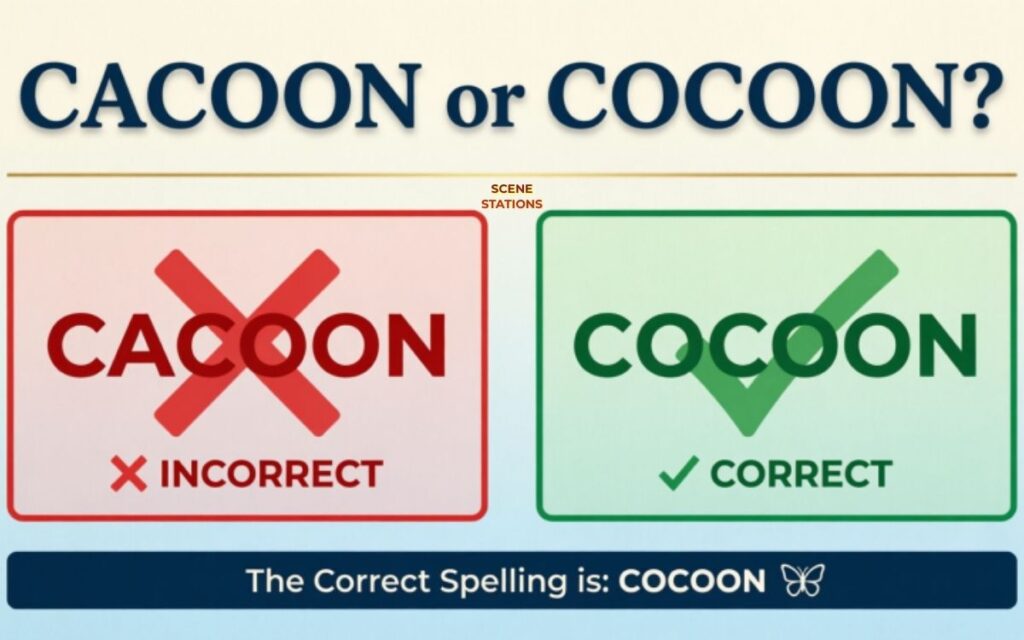
Here’s the short answer: cocoon is the word you want almost every single time. Cacoon is real too, but it means something completely different and it has nothing to do with caterpillars.
Let’s break down exactly why this mix-up happens, what each word actually means, and how to never second-guess yourself again.
Quick Answer: Cocoon Is Correct (Here’s the One Exception)
If you’re writing about an insect, a safe feeling, or “shutting yourself away” from the world, the word is cocoon. It’s the spelling found in every major dictionary, including Merriam-Webster and the Oxford English Dictionary, and it’s the one teachers, editors, and style guides expect.
Cacoon isn’t a typo in every case, though. It’s a legitimate English word just for a tropical plant, not an insect. So:
- Writing about silkworms, moths, or feeling “wrapped up and safe”? Use cocoon.
- Writing about a tropical climbing vine with giant seed pods? Cacoon is correct there.
If you’re not specifically discussing that plant, cacoon is almost certainly a mistake.
Why People Mix Up Cacoon and Cocoon?
This isn’t a random error. A few things make “cacoon” feel like a believable spelling:
- They sound identical when spoken. Nothing in the pronunciation hints at which vowel comes first.
- English double-O words are inconsistent. Balloons, raccoons, and saloons all use “a” before the double O, so the brain assumes cocoons should follow the same pattern.
- Autocorrect doesn’t always catch it. Since “cacoon” is a real dictionary entry (just for a plant), most spellcheckers won’t flag it as wrong.
- Visual memory plays tricks. People often remember the general shape of a word rather than its exact letters, and “cacoon” looks close enough to pass at a glance.
Once you know the reason behind the confusion, the fix is easy and we’ll give you a memory trick further down that makes it permanent.
What Is a Cocoon? The Real Definition
A cocoon is a protective silk casing that certain insect larvae spin around themselves before they transform into adults. Think of it as a built-in sleeping bag for metamorphosis it shields the developing insect from predators, weather, and parasites while its body completely rebuilds itself.
Key facts about cocoons:
| Detail | Information |
| Made by | Moths, silkworms, and several other insect species |
| Material | Silk threads produced from the larva’s salivary glands |
| Function | Protects the pupa during metamorphosis |
| Duration | Anywhere from a few days to several months |
| Word origin | French cocon (“shell”), from Latin coccum |
How a Moth Uses Its Cocoon
A moth’s life cycle moves through four clear stages:
- Egg – The adult female moth lays eggs, usually on leaves.
- Larva – The caterpillar hatches and eats constantly to build energy reserves.
- Pupa – The caterpillar spins its cocoon and enters the pupal stage inside it.
- Adult moth – After full transformation, the moth emerges from the cocoon.
Inside that silk casing, the insect doesn’t just “grow wings.” Its entire body breaks down and reassembles into a different form one of the most dramatic transformations in the natural world.
Cocoon vs. Chrysalis: They’re Not the Same Thing
A lot of people use “cocoon” and “chrysalis” as if they’re interchangeable. They’re not, and the difference matters if you want to get your biology right.
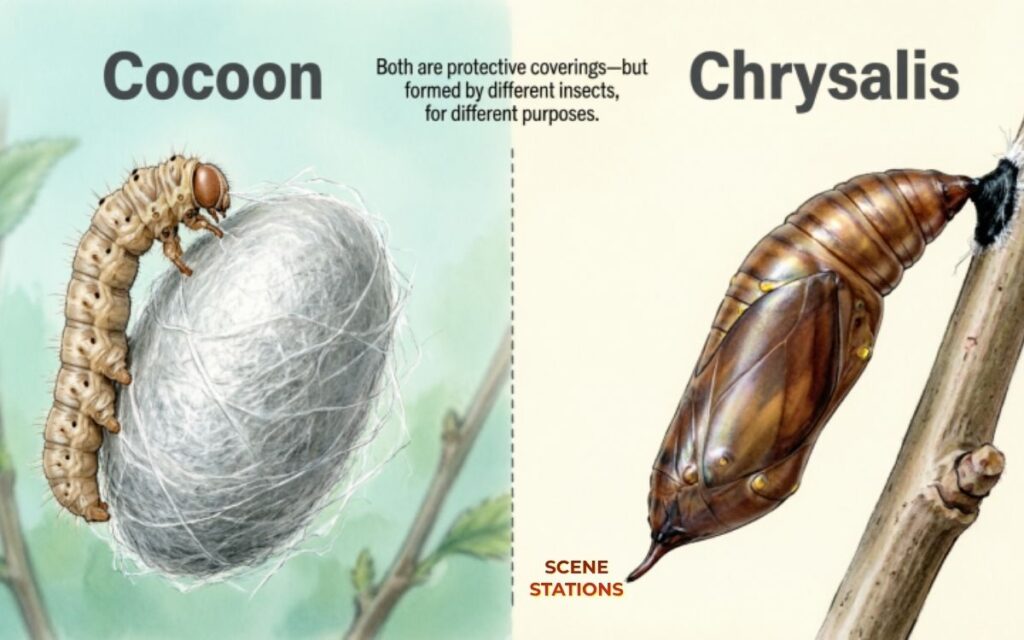
| Feature | Cocoon | Chrysalis |
| Made by | Moths | Butterflies |
| Material | Silk spun by the larva | The caterpillar’s own hardened skin |
| Type of structure | External silk wrapping | Internal pupal casing |
| Example | Silkworm cocoon | Monarch butterfly chrysalis |
Simple way to remember it: Moths spin cocoons. Butterflies form chrysalises. One is woven from the outside; the other forms from the caterpillar’s own body.
“Cacoon” Has a Real Meaning Too Just Not This One
Here’s where most articles get sloppy, so let’s be precise: cacoon refers to a tropical vine that produces unusually large, hard seed pods. You’ll see it written about in two slightly different ways depending on the source some call it Entada rheedii (also known as the sea heart or monkey ladder vine, found in parts of Africa, Asia, and the Caribbean), while other references point to Fevillea cordifolia (sometimes called the snuffbox bean, native to Central and South America). Both are real tropical plants with hard-shelled seed pods that share the regional nickname “cacoon,” which is likely why you’ll find both names attached to the word.
What’s consistent across sources:
- The seeds are large, flat, and have an unusually hard outer shell.
- In parts of the Caribbean and West Africa, the dried seeds have traditionally been used in folk medicine for muscle pain and inflammation.
- The seed pods are buoyant enough to drift across ocean currents, which is partly how the plant spread to different coastlines.
So if you ever see “cacoon tea” or “cacoon bean” mentioned, that’s this plant not a spelling slip. But outside botany, you won’t run into it much in everyday English.
Where You’ll Actually Encounter “Cacoon” in Real Life
Realistically, most readers will never need to use “cacoon” at all. It shows up almost exclusively in:
- Botanical or agricultural writing about tropical vines and seed pods
- Travel or cultural content describing Caribbean and West African herbal remedies
- Craft and jewelry contexts, since the hard seed shells are sometimes carved or polished for decorative pieces
If your writing falls outside these niches, you can safely assume any “cacoon” you encounter is meant to be “cocoon.”
Coco………………on as a Metaphor: It’s Not Just About Insects
Cocoon escaped the biology textbook a long time ago. In everyday English, it’s now one of the most common words for describing emotional or physical protection.
Common figurative meanings:
- Comfort – being wrapped in warmth or coziness
- Safety – a private space that feels protected
- Isolation – choosing to withdraw from the world, often to recover or focus
Examples in context:
- She cocooned herself in blankets after a long week.
- The startup built its product in a cocoon, away from public scrutiny, before launching.
- He’s been cocooning at home all winter instead of going out.
Where “Cocooning” Came From
The term cocooning was coined in the 1980s by trend forecaster Faith Popcorn to describe people choosing to stay home and shield themselves from the outside world. It’s stuck around and expanded. Today you’ll hear variations like:
- Digital cocooning – disappearing into phones, streaming, or online spaces
- Emotional cocooning – pulling back from stress, conflict, or social pressure
Pop culture references like this show up everywhere once you start looking the same way slang and quote culture spreads online, like the surge of interest around XXXTentacion’s real quotes.
How to Use “Cocoon” as a Verb
Cocoon isn’t just a noun. It also works as a verb meaning to wrap up, enclose, or shelter something.
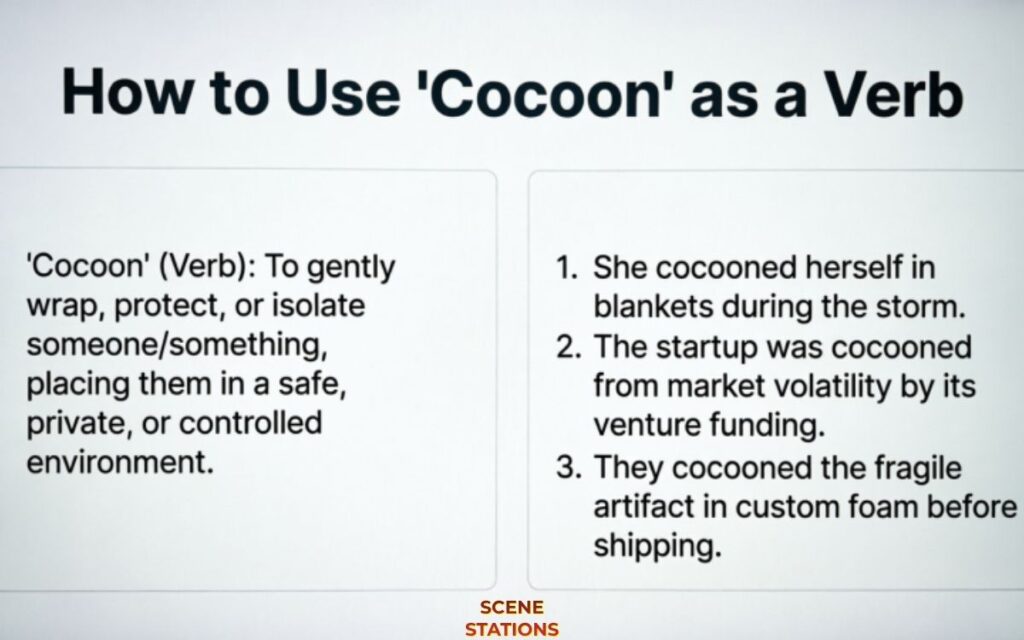
Verb forms:
- Base: cocoon
- Past tense: cocooned
- Continuous: cocooning
Examples:
- The baby is cocooned in a soft blanket.
- Snow cocooned the cabin overnight.
- She’s been cocooning herself away from social media lately.
Similar words you can swap in: encase, enclose, wrap up, shelter, insulate.
If you enjoy untangling confusing language, you’ll probably also like figuring out what slang like what “6 7” actually means or the real meaning behind “orgo” slang different kind of confusion, same satisfying “oh, that’s what it means” moment.
Real-World Examples of “Cocoon” in Different Contexts
Seeing a word used across different settings makes it much easier to remember correctly. Here’s how “cocoon” shows up in real writing:
Scientific:
- The silkworm’s cocoon contains nearly a kilometer of continuous silk thread.
- Researchers studied how temperature affects the duration of the pupal stage inside the cocoon.
Everyday and emotional:
- After the breakup, she spent the weekend cocooned in blankets with easy food.
- He’s been in a bit of a cocoon since starting the new job, quiet, focused, not going out much.
Business and creative:
- The design team worked in a cocoon for months before revealing the final product.
- Their early albums were created in a kind of creative cocoon, away from label pressure.
Pop culture:
- The 1985 film “Cocoon” used the word in its title to explore themes of aging and renewal.
Notice that in almost every one of these, “cocoon” signals protection, transformation, or withdrawal whether that’s a literal insect or a person taking a break from the world.
Other Word Pairs That Cause the Same Kind of Confusion
“Cacoon or cocoon” isn’t an isolated case. English has plenty of similar-sounding pairs where one spelling dominates and the other has a narrow, specific meaning elsewhere:
| Pair | Common Spelling | Less Common / Different Meaning |
| Cacoon / Cocoon | Cocoon (insect casing, metaphor) | Cacoon (tropical vine) |
| Complement / Compliment | Both correct, different meanings | Complement = “completes,” Compliment = “praise” |
| Hassle / Hastle | Hassle (correct) | “Hastle” is simply a misspelling |
| Raccoon / Racoon | Raccoon (standard) | “Racoon” is an accepted but less common variant |
The pattern here is the same one that trips people up with cocoon: pronunciation doesn’t map cleanly onto spelling, so writers default to whichever version “looks right” in the moment. Knowing the exception in this case, the cacoon plant is what separates a confident writer from someone guessing.
Cacoon or Cocoon: Quick Comparison Table
| Scenario | Correct Word | Example Sentence |
| Insect’s silk casing | Cocoon | The silkworm spun a cocoon before transforming. |
| Feeling safe or withdrawn | Cocoon | He cocooned himself at home all weekend. |
| Tropical seed-pod vine | Cacoon | The cacoon vine’s seeds can float across oceans. |
| Everyday spelling mistake | Cocoon (not cacoon) | She wrapped herself in a cocoon. |
A Simple Trick to Never Mix Them Up Again
Here’s a memory hook that actually works: think of the double “oo” in cocoon as two eyes peeking out of a snug silk wrap round, closed, protected. That visual is exactly what a cocoon deserves.
If you still hesitate, just ask yourself: “Am I talking about an insect, comfort, or isolation?” If yes, it’s always cocoon. The only time “cacoon” is correct is when you’re specifically naming that tropical vine and you’ll usually know it when that’s the topic.
Frequently Asked Questions
Is it cacoon or cocoon?
Cocoon is the correct spelling when referring to the silk casing insects spin, or the figurative sense of comfort and protection. Cacoon is only correct when referring to a specific tropical vine and its seed pods.
Is cacoon a real word?
Yes, but it’s narrow in scope. It names a tropical climbing plant with hard seed pods, used in some folk traditions. Outside that context, “cacoon” is almost always a misspelling of “cocoon.”
What’s the difference between a cocoon and a chrysalis?
Moths spin cocoons out of silk. Butterflies form a chrysalis from their own hardened skin. They serve a similar protective purpose but come from different processes.
Can cocoon be used as a verb?
Yes. “Cocoon” as a verb means to wrap, enclose, or shelter — for example, “She cocooned herself in a blanket.”
Why do “cacoon” and “cocoon” sound the same?
Because English spelling doesn’t always match pronunciation. Words like balloon, raccoon, and saloon follow an “a + double O” pattern, which makes “cacoon” feel plausible even though it’s the wrong choice for the insect meaning.
What is the plural of cocoon?
The plural is simply cocoons.
Where does the word “cocoon” come from?
It traces back to the French word cocon, meaning “shell,” which itself comes from the Latin coccum (“berry” or “shell”). The word entered English usage centuries ago to describe the silky envelope spun by silkworms.
Is “cacoon” used anywhere outside of botany?
Rarely. Outside discussions of the tropical vine and its seed pods, “cacoon” almost never appears as an intentional word choice — it’s typically a misspelling of “cocoon.”
Does autocorrect catch the cacoon/cocoon mistake?
Not always. Because “cacoon” is a real dictionary word in its own right (referring to the plant), many spellcheckers won’t flag it as an error even when you meant “cocoon.” That’s exactly why this mix-up spreads so easily in casual writing. The same way texting shorthand like LMS in slang gets misread because the letters look like one thing but mean another.
The Bottom Line
When in doubt, go with cocoon it covers insects, comfort, isolation, and everything you’d use this word for in daily writing. Save cacoon for the one specific situation where you’re talking about the tropical vine and its seed pods. Get that one distinction right, and you’ll never second-guess this spelling again.
And if you’re polishing up your captions or bio next, here’s a related read: stylish WhatsApp bio ideas for when you want your words to sound just as intentional as your spelling.

Ash Williom has spent years writing puns, wordplay, and internet slang guides for Scenestations.com, with a habit of testing every joke on real friends and family before it makes the list. When not chasing down the perfect one-liner, Ash is usually knee-deep in group chats collecting new material or digging into how internet slang actually spreads across platforms.